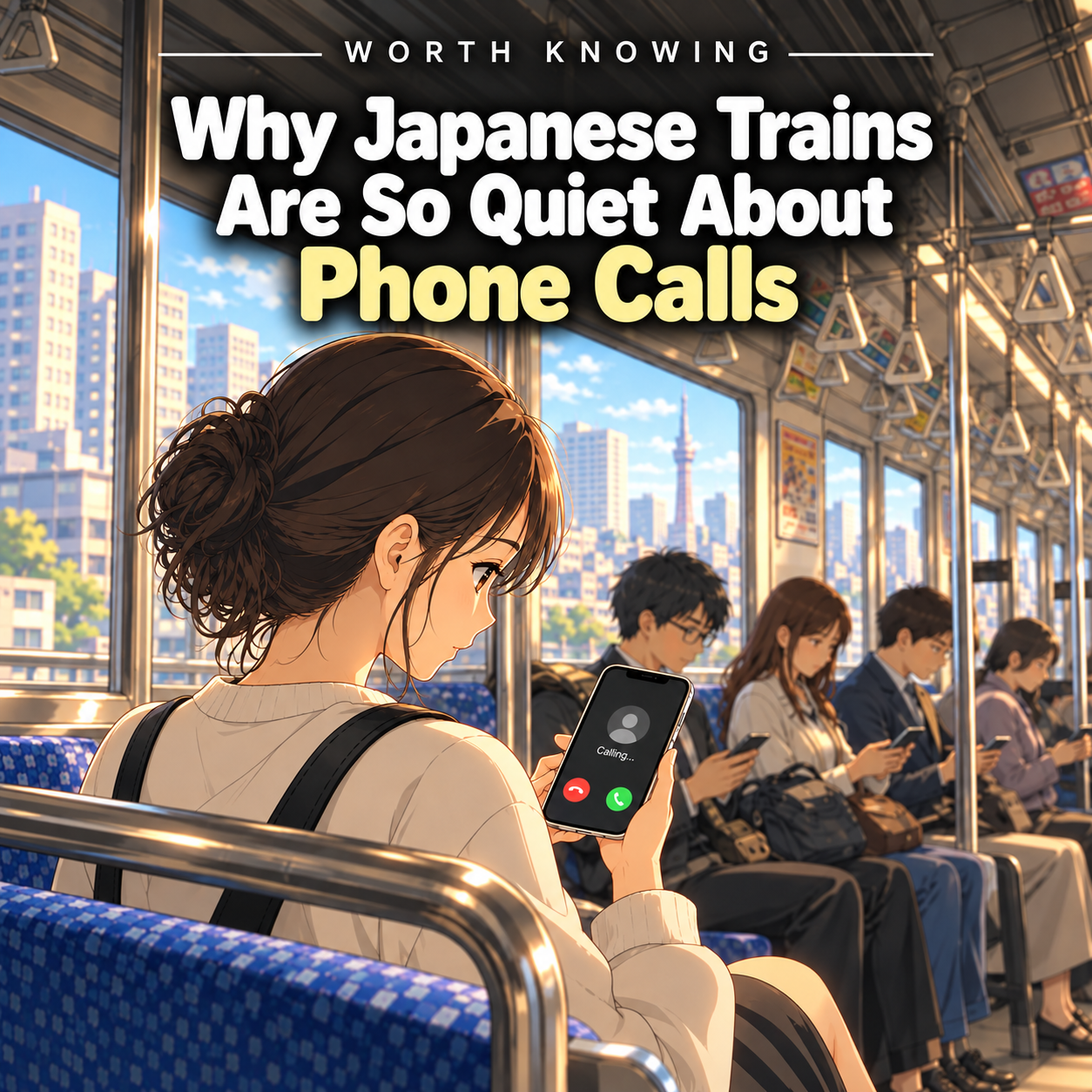
Ride a commuter train in Japan and you will probably notice the same pattern: people scroll, text, read, watch videos with earphones, and play games, yet phone conversations are surprisingly rare.
The reason is not simply “phones are banned.” Major railway operators frame the issue as passenger manners: keep your device quiet, avoid voice calls, and be especially careful around priority seats when a train is very crowded.
Most operators ask riders to use manner mode
Tokyo Metro tells passengers to set phones to manner mode and refrain from talking on the phone while onboard. JR East uses similar guidance: away from priority seats, passengers are asked to use manner mode and avoid calls.
That distinction matters. Quiet phone use itself is normal. Texting, browsing, reading, and other silent activities are part of everyday train life. It is the voice call that riders are generally expected to avoid.
The request is reinforced again and again through onboard announcements, stickers, posters, and station messaging. Rather than relying on a single hard rule, the system works through repeated reminders and shared expectations about how to behave in a crowded public space.
Why are priority seats treated differently?
Priority-seat areas have an additional layer of guidance.
Tokyo Metro currently asks passengers near priority seats to switch off mobile phones and tablets when the train is crowded enough that passengers’ bodies are touching. JR East uses the same basic wording: near priority seats, phones should be switched off when crowded.
This wording reflects the history of Japanese railway guidance around wireless signals and implanted medical devices.
In 2015, Tokyo Metro explained that railway operators were revising their messaging after a 2013 update to national guidance on preventing radio-wave effects on implanted medical devices, along with changes in how mobile phones were being used. From October 1, 2015, 37 operators across Kanto, Tohoku, and Koshinetsu shifted to the message that phones near priority seats should be turned off when crowded, rather than at all times.
The rule used to be stricter
The modern wording is different from what riders were told in the early 2000s.
In 2003, JR East announced a new unified message for train-phone etiquette: passengers near priority seats were asked to switch their phones off, while passengers elsewhere were asked to use manner mode and refrain from calls.
That made the priority-seat rule much stricter than it is today.
The 2015 revision softened that guidance. Operators kept the general request to avoid phone calls throughout the train, but changed the priority-seat instruction to “switch off when crowded.”
So why do Japanese trains stay so quiet?
The silence comes from several things working together:
- Repeated railway announcements and signage
- A strong expectation not to disturb other passengers
- A distinction between silent phone use and voice calls
- Specific priority-seat guidance when trains are heavily crowded
- Years of consistent messaging across major railway operators
Because the expectation is so familiar, riders often respond to an incoming call by declining it, sending a message, or waiting until they leave the train.
The result is something visitors often notice immediately: even when a train is packed, the carriage can remain remarkably quiet.
Are there any exceptions?
Yes. Some specially designated work-oriented Shinkansen cars explicitly allow phone calls and web meetings from the seat.
JR East’s TRAIN DESK cars allow calls and web meetings at the seat, while asking passengers to keep their voices low and remain considerate of others. Outside those cars, JR East says passengers should continue to keep phones on manner mode and refrain from calls at their seats.
JR Central’s S Work cars on the Tokaido and Sanyo Shinkansen also allow phone calls and web meetings from the seat, again with consideration for surrounding passengers.
These are designed exceptions, not the normal expectation on an ordinary commuter train.
What visitors should remember
If you are riding a train in Japan, the easiest rule is simple:
Using your phone quietly is usually fine. Talking on it usually is not.
Keep your phone on silent, use headphones for audio, and if someone calls, wait until you get off or move to an area where calls are specifically permitted.
That small habit helps explain one of the most noticeable features of Japanese public transport: a shared effort to keep the ride calm for everyone.